

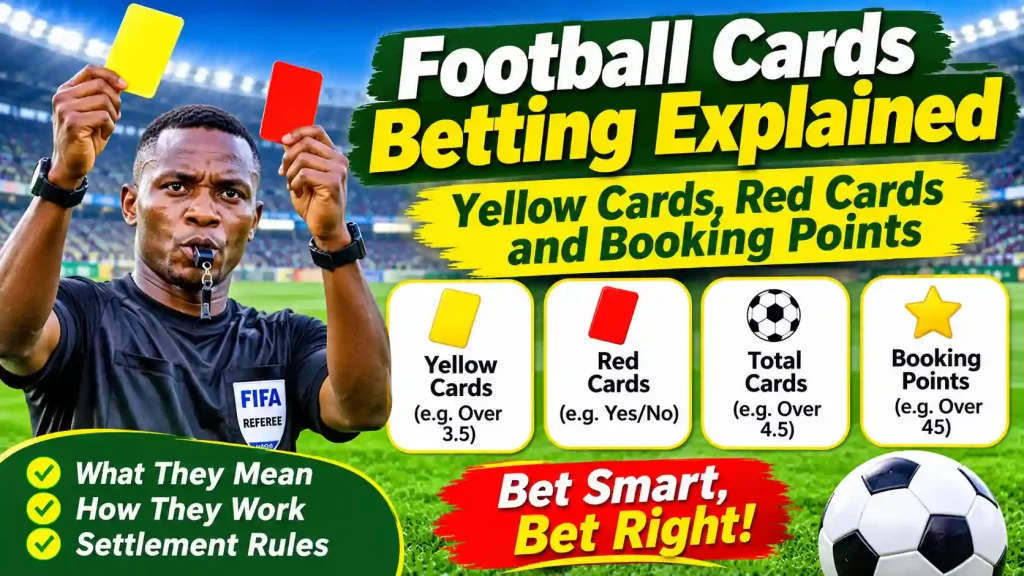

Football cards betting is a market where the prediction is based on the yellow cards, red cards or booking points recorded during a football match. Instead of predicting the final score or the number of goals, you are looking at disciplinary events and how the teams are treated by the referee.
This guide to Football Cards Betting Explained covers total match cards, team cards, yellow-card and red-card markets, booking points, over/under card lines and the settlement rules that can affect a result. It also explains why different bookmakers may count the same incident differently.
For Nigerian football fans learning about betting markets, understanding these differences is important. A market labelled “total cards” may not use the same counting method as a “booking points” market. Never assume that every betting operator uses identical rules.

Before exploring card markets, it helps to understand how different football betting markets work and why their settlement conditions matter. Read our guide to common football betting markets and settlement rules.
What Is Football Cards Betting?
Football cards betting is a type of football market based on the disciplinary cards shown by the referee during a match.
The two main types of cards are:
- Yellow card: A caution shown to a player for an offence or misconduct under the Laws of the Game.
- Red card: A dismissal that requires a player to leave the field and take no further part in the match.
A player can receive a straight red card or be sent off after receiving a second yellow card. How these incidents are counted for betting purposes depends on the operator’s settlement rules.
For example, a bookmaker may offer a market asking whether there will be more than 4.5 total cards in a match. Another market may ask whether the home team will receive more cards than the away team. A booking-points market may use a points system instead of a simple card count.
These are separate markets, so it is important to understand exactly what each selection measures.
Main Types of Football Cards Betting Markets
There are several types of card-related markets. The names and availability can differ between betting platforms, but the following are common examples.
1. Total Cards Betting
Total cards betting means predicting the combined number of cards recorded for both teams during a match, according to the bookmaker’s definition.
For example, imagine a hypothetical match between Team A and Team B.
- Team A receives three yellow cards.
- Team B receives two yellow cards.
- No red cards are shown.
If the operator counts each yellow card as one card, the match total is five cards.
You may see selections such as:
- Over 3.5 cards
- Under 3.5 cards
- Over 4.5 cards
- Under 4.5 cards
- Over 5.5 cards
- Under 5.5 cards
Example: Over 4.5 total cards
Suppose a match finishes with five cards under the operator’s counting rules.
- Over 4.5 cards: Wins with five or more cards.
- Under 4.5 cards: Wins with four or fewer cards.
This example uses a half-card line, so there is no exact tie at 4.5.
However, the calculation is only correct after confirming how that operator counts red cards and second-yellow dismissals.
2. Team Cards Betting
Team cards betting focuses on the number of cards received by one selected team rather than both teams combined.
For example, a market may ask whether the home team will receive over or under 2.5 cards.
Imagine this hypothetical result:
| Team | Yellow cards | Red cards |
|---|---|---|
| Home team | 3 | 0 |
| Away team | 1 | 1 |
The home team has three yellow cards. The away team has one yellow card and one red card. The final betting count depends on the operator’s card-scoring rules.
Common team-card market descriptions include:
- Home team total cards
- Away team total cards
- Home team over/under cards
- Away team over/under cards
- Team to receive the most cards
A team-card market is not the same as a total match cards market. The first focuses on one side, while the second combines the eligible cards from both sides.
3. Yellow Card Betting
Yellow card betting focuses specifically on cautions shown to players.
Depending on the platform, you may see markets such as:
- Total yellow cards
- Home team yellow cards
- Away team yellow cards
- Over/under yellow cards
- Which team will receive more yellow cards
For example, a selection of over 3.5 yellow cards requires at least four qualifying yellow cards under the market’s rules.
Does a second yellow card count as another yellow card?
This is one of the most important details to check.
A player who receives two yellow cards in the same match is sent off after the second caution. However, operators may treat the second yellow and the resulting red card differently for settlement.
Some rules exclude the second yellow as a separate count when calculating bookings or booking points. Others define the total-card treatment using a maximum number of cards per player.
Do not automatically add every card displayed during a dismissal sequence. Read the operator’s specific rules.
4. Red Card Betting
Red card betting focuses on whether a player will be sent off or whether a red card will be shown during the match.
Possible markets include:
- Will there be a red card?
- Total red cards
- Home team to receive a red card
- Away team to receive a red card
- Which team will receive the first red card
A straight red card and a dismissal following two yellow cards are different disciplinary situations. A bookmaker may also use a different counting method for a red-card market than it uses for total cards or booking points.
Does a red card always count as two cards?
No. There is no universal answer across all operators.
For example, MSport’s published Nigerian football settlement rules count a yellow card as one card and a red or yellow-red card as two. Its rules also specify that the second yellow leading to a yellow-red dismissal is not counted separately.
Betfair’s published total-card rules use a different method: a straight red is one card, while two yellow cards leading to a sending-off count as two cards in total.
These are examples of operator-specific rules, not rules that every bookmaker must follow. Check the terms attached to the market you are reading.
What Are Booking Points in Football Betting?
Booking points are a scoring system that assigns a numerical value to yellow and red cards. Instead of simply adding the number of cards, the bookmaker calculates a points total.
One published system used by operators such as MSport is:
| Card type | Example booking points |
|---|---|
| Yellow card | 10 points |
| Red card | 25 points |
| Yellow card followed by a second-yellow dismissal | Up to 35 points for that player under the stated rules |
The points above are an example of a bookmaker’s published system. They should not be treated as a universal standard.
How Are Booking Points Calculated?
Under a system that awards 10 points for a yellow card and 25 for a red card, the calculation is straightforward once the operator’s rules are confirmed.
Example 1: Three yellow cards
Suppose three different players receive one yellow card each.
- Player A: 10 points
- Player B: 10 points
- Player C: 10 points
Total booking points = 30.
Example 2: One straight red card
Suppose one player receives a straight red card and the operator assigns 25 points to a red card.
Total booking points = 25.
Example 3: A player is dismissed after two yellow cards
Suppose a player receives a yellow card and later receives a second yellow that results in a red card.
Under a system that awards 10 points for the first yellow and 25 points for the dismissal, while not counting the second yellow separately, the player contributes 35 points.
The exact treatment must be checked against the bookmaker’s rules. Do not assume the player automatically contributes 45 points by adding 10 + 10 + 25.
Booking Points vs Total Cards: What Is the Difference?
These markets measure different things.
| Feature | Total cards | Booking points |
|---|---|---|
| Main purpose | Counts qualifying cards | Adds points assigned to cards |
| Yellow card | Count depends on operator rules | Has a defined points value |
| Red card | May count as one or more cards | Has a points value |
| Second yellow | Treatment depends on the rules | May not be counted separately |
| Market example | Over 4.5 cards | Over 45 booking points |
A match can have a relatively small number of cards but a higher booking-points total if a dismissal occurs. That is why the two markets should not be treated as interchangeable.
How Over and Under Cards Betting Works
Over/under cards betting asks whether the qualifying card total will be above or below a displayed line.
The line may be shown as 2.5, 3.5, 4.5, 5.5 or another number.
Understanding the displayed price is another important part of reading a market. Our guide to understanding decimal odds and potential returns explains how football betting odds work.
Understanding Half-Card Lines
Half-card lines make the outcome easier to interpret because a match cannot finish with exactly half a card.
| Market | Winning condition |
|---|---|
| Over 2.5 cards | At least 3 qualifying cards |
| Under 2.5 cards | No more than 2 qualifying cards |
| Over 3.5 cards | At least 4 qualifying cards |
| Under 3.5 cards | No more than 3 qualifying cards |
| Over 4.5 cards | At least 5 qualifying cards |
| Under 4.5 cards | No more than 4 qualifying cards |
| Over 5.5 cards | At least 6 qualifying cards |
| Under 5.5 cards | No more than 5 qualifying cards |
These examples assume the operator’s final eligible card total has already been calculated.
What Happens With a Whole-Number Card Line?
A whole-number line, such as 4.0 or 5.0, can have a different settlement condition.
In some over/under markets, if the final total equals the line, the selection is a push and the stake is returned. In Asian markets, a stake may also be split across adjacent lines.
Do not assume every whole-number card market uses the same settlement method. Look for the operator’s explanation of pushes, refunds and Asian card lines.
What Factors Can Affect the Number of Football Cards?
Card markets are based on referee decisions and match events. No statistical measure can guarantee how many cards will be shown.
When studying a match, the following factors may provide context.
1. Playing Style of Both Teams
Teams that press aggressively, defend with physical challenges or frequently contest possession may be involved in more situations that attract referee attention.
However, an aggressive style does not automatically mean a team will receive more cards. The referee’s decisions and the match situation still matter.
2. Importance of the Fixture
Some matches carry greater sporting importance because of league positions, qualification targets or rivalry.
A tense match can involve more protests, tactical fouls and challenges, but fixture importance alone does not establish how many cards will be shown.
3. Previous Disciplinary Records
A team’s previous yellow and red card statistics can provide background information.
When checking historical records, make sure that the data relates to the relevant competition and a comparable number of matches. A short sample can create a misleading impression.
4. Referee’s Disciplinary Record
Different referees may have different approaches to cautions, player protests and physical challenges.
If referee statistics are available, check the source, competition and time period. A referee’s historical average is not a promise that the same number of cards will appear in the next match.
5. Match Situation and Tactical Pressure
A close score, a team protecting a lead or a side trying to stop a dangerous counterattack can change the types of challenges made during a match.
Late pressure may lead to tactical fouls or confrontations, but a card is still a decision made by the referee.
6. Team News and Player Availability
The absence of a regular defender or defensive midfielder can change a team’s approach. A player returning from suspension or an injury may also affect team selection.
These details are context for analysis, not proof of a future card total.
Important Football Cards Betting Settlement Rules
Understanding the settlement rules is just as important as understanding the market name.
Two betting platforms can display a similar card selection but calculate the result differently.
1. Yellow Card and Red Card Counting
Check how the operator defines each card for the market.
Some operators count a yellow as one card and a red as two. Others count a straight red as one card. A second-yellow dismissal may also receive special treatment.
Never calculate a card total using assumptions from another platform.
2. Cards Shown to Substitutes and Managers
Some operators count only cards shown to players who are actively taking part in the match.
Cards shown to managers, coaches, players on the bench or players who have already been substituted may be excluded.
The exact wording matters. A substitute who later enters the pitch may be treated differently from an unused substitute who receives a card while on the bench.
3. Cards During Half-Time
A card shown during the half-time interval may be assigned to a particular period under the bookmaker’s rules.
For example, MSport’s published football rules state that cards shown during the half-time break are settled as cards shown in the second half.
This matters when reading first-half and second-half card markets. Check the period-specific rules rather than assuming that every platform assigns half-time incidents in the same way.
4. Cards After the Final Whistle
Many standard card markets exclude cards shown after the full-time whistle.
However, the operator’s market rules determine the exact cut-off. Do not assume a post-match incident will be included simply because the referee shows a card after the game has ended.
5. Extra-Time and Penalty Shootouts
Standard football markets commonly use the 90 minutes of normal play, including referee-added stoppage time.
Extra-time and penalty shootouts are generally excluded unless the market clearly states otherwise.
A match that goes to extra-time can therefore finish with more cards on the official match record than are included in a standard 90-minute betting market.
6. Abandoned or Interrupted Matches
If a football match is abandoned, suspended or interrupted, the bookmaker may apply special settlement conditions.
The treatment can depend on whether the match resumes within a stated period, whether the market outcome has already been determined and whether the operator’s rules require undecided selections to be voided.
For a fuller explanation, read our guide to abandoned football match betting rules.
How to Check a Football Cards Market Before Making a Decision
Before evaluating any card market, read the selection and rules carefully.
- Identify the market: Confirm whether it is total cards, team cards, yellow cards, red cards or booking points.
- Check the time period: Confirm whether it covers the first half, second half or the full 90 minutes.
- Read the card-counting method: Find out how yellow cards, straight reds and second-yellow dismissals are counted.
- Check player eligibility: Look for rules about substitutes, substituted players, managers and coaches.
- Read the settlement conditions: Check what happens with extra-time, half-time incidents, post-match cards and abandoned matches.
- Confirm the line and odds: Make sure you understand the exact selection and price displayed.
It is also useful to understand how to read a football betting slip, including the selected market, displayed odds and accepted bet details.
Common Mistakes in Football Cards Betting
Assuming every red card counts as two cards
This is not a universal rule. Operators can use different card-counting methods.
Confusing booking points with total cards
A points market adds assigned values to cards. It does not simply count every card as one.
Ignoring second-yellow dismissals
A second yellow that results in a red card can have special treatment for both card totals and booking points.
Counting cards shown to everyone on the touchline
Managers, coaches, unused substitutes and substituted players may be excluded under the applicable rules.
Forgetting the 90-minute settlement period
A card shown in extra-time may not count in a standard 90-minute market.
Assuming the live score or statistics display decides settlement
A live match tracker can be delayed or corrected. The operator’s stated settlement source and rules determine the official result for the market.
Treating historical card averages as guarantees
Past statistics can help describe previous matches, but they cannot guarantee the number of cards in a future fixture.
Frequently Asked Questions About Football Cards Betting
What does football cards betting mean?
Football cards betting is a market based on yellow cards, red cards or booking points recorded during a match. The available selections and counting rules depend on the betting operator.
What is the difference between total cards and team cards?
Total cards combines the qualifying cards from both teams. Team cards counts the eligible cards for one selected team, such as the home side or away side.
Does a red card count as one or two cards?
It depends on the operator and market. Some rules count a straight red as one card, while others count a red as two. Always read the market’s settlement rules.
How many points is a yellow card in booking points betting?
Some operators award 10 booking points for a yellow card and 25 for a red card. This is a published example, not a universal standard across all bookmakers.
How many points is a red card?
Under a commonly published 10/25 booking-points system, a red card is worth 25 points. A second-yellow dismissal may have additional conditions, including a maximum of 35 points for one player.
Does a second yellow card count separately?
Not always. Some operators do not count the second yellow separately when it leads to a red card. The applicable total-card and booking-points rules determine the calculation.
Do cards shown to substitutes count?
It depends on the operator. Some rules exclude cards shown to substitutes who are not actively playing, while other rules may treat a substitute who later enters the match differently.
Do cards in extra-time count?
Standard 90-minute markets commonly exclude extra-time cards unless the selection specifically includes extra-time or the bookmaker states otherwise.
Do cards shown after full time count?
Many standard card markets exclude cards shown after the final whistle. Check the operator’s specific settlement rules for the market.
What does over 4.5 cards mean?
It means the eligible card total must be at least five for the over selection to win. The operator’s counting rules determine which yellow and red cards contribute to that total.
What is the difference between booking points and booking count?
Booking count measures the number of qualifying bookings using the operator’s card-counting method. Booking points assigns numerical values to different card types and adds those values together.
Can football card statistics guarantee a result?
No. Historical statistics, referee records and team discipline may help explain previous patterns, but they cannot guarantee future card decisions or a winning outcome.
Final Thoughts: Understand the Rules Before Reading a Cards Market
Football cards betting includes several different markets, including total cards, team cards, yellow cards, red cards and booking points. Although the market names may appear similar across betting platforms, the settlement methods can differ.
The most important detail is to check how the operator counts straight red cards, second-yellow dismissals, cards shown to substitutes and incidents during extra-time or after the final whistle.
Understanding these differences helps readers interpret football betting terminology more accurately and avoid confusing card totals with booking points.
TopNigeriaSport.com publishes independent educational content about football betting terminology, market rules, odds and responsible play. We do not accept bets, open betting accounts or receive deposits. No betting market or statistical analysis can guarantee a winning result.
18+ educational content. Gambling involves financial risk. Never stake money needed for essential expenses.

