
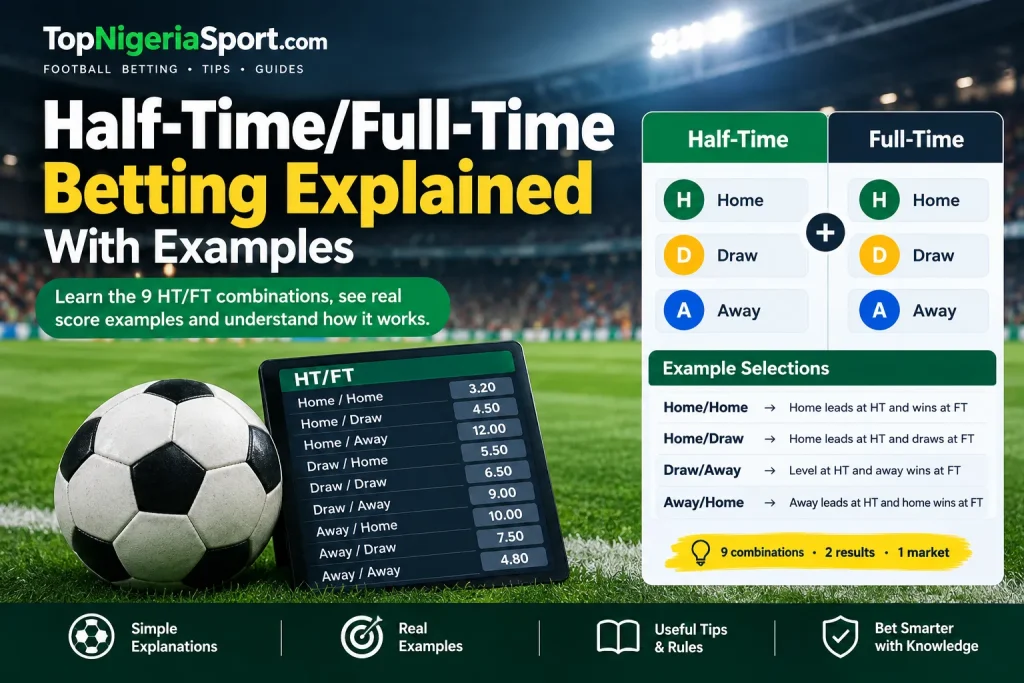

Half time full time betting is a football betting market where you predict two results in the same match: the result at half-time and the result at full-time. Often shortened to HT/FT, this market has nine possible combinations, including Home/Home, Draw/Home and Away/Draw.
For beginners learning about football betting in Nigeria, understanding these combinations is important because both parts of an HT/FT selection must be correct for the bet to win. This guide explains how half-time/full-time betting works, what each selection means, and how to understand the results using simple football score examples.
Quick answer: In half-time/full-time betting, the first selection represents the result at half-time, while the second represents the result at full-time. For example, Home/Draw means the home team leads at half-time but the match finishes level.

What Does Half-Time/Full-Time Betting Mean?
Half-time/full-time betting asks you to predict the match result at two different points in a football game.
- Half-time (HT): The result when the first half ends, including applicable first-half stoppage time.
- Full-time (FT): The overall match result at the end of normal playing time, including applicable stoppage time, under the bookmaker’s rules.
Each result has three possible outcomes:
- Home: The home team is winning.
- Draw: Both teams have the same score.
- Away: The away team is winning.
Combining these three half-time results with the three full-time results creates nine possible HT/FT combinations.
For a broader introduction to football markets, read our football betting guide for Nigerian beginners.
What Are the Nine Half-Time/Full-Time Betting Outcomes?
The following table explains all nine selections and gives an illustrative score example for each one.
| HT/FT selection | What it means | Half-time score | Full-time score |
|---|---|---|---|
| Home/Home | Home team leads at half-time and wins the match | 1–0 | 2–0 |
| Home/Draw | Home team leads at half-time, but the match ends level | 1–0 | 1–1 |
| Home/Away | Home team leads at half-time, but the away team wins | 1–0 | 1–2 |
| Draw/Home | Match is level at half-time, then the home team wins | 0–0 | 2–0 |
| Draw/Draw | Match is level at half-time and full-time | 0–0 | 1–1 |
| Draw/Away | Match is level at half-time, then the away team wins | 0–0 | 0–1 |
| Away/Home | Away team leads at half-time, but the home team wins | 0–1 | 2–1 |
| Away/Draw | Away team leads at half-time, but the match ends level | 0–1 | 1–1 |
| Away/Away | Away team leads at half-time and wins the match | 0–1 | 0–2 |
These are hypothetical examples, not predictions for actual matches. The score at full-time is the total score for the match, not simply the scoreline from the second half.
How Does Half-Time/Full-Time Betting Work?
To understand how HT/FT works, imagine a football match between a home team and an away team.
Suppose you select Draw/Home.
- The score must be level at half-time.
- The home team must finish the match with more goals than the away team.
- If both conditions are met, the selection wins according to the market rules.
- If the score is not level at half-time, or the home team does not win at full-time, the selection loses.
For example, if the half-time score is 0–0 and the final score is 2–0, Draw/Home is the matching selection.
However, if the half-time score is 1–0 and the final score is 2–0, Home/Home is the matching selection instead.
This is why you must understand both parts of the selection before interpreting an HT/FT market.
Half-Time/Full-Time Betting Examples
Example 1: Home/Home
Suppose the home team leads 1–0 at half-time and wins 2–0 at full-time.
The home team was ahead at both stages, so Home/Home matches the result.
Example 2: Draw/Home
Suppose the teams are level at 0–0 at half-time. The home team scores twice in the second half, and the match finishes 2–0.
The half-time result was a draw, and the full-time result was a home win. The matching selection is Draw/Home.
Example 3: Home/Away
Suppose the home team leads 1–0 at half-time, but the away team scores twice after the break. The final score is 1–2.
The home team led at half-time, but the away team won the match. The matching selection is Home/Away.
Example 4: Draw/Draw
Suppose the score is 1–1 at half-time and remains 1–1 at full-time.
The match was drawn at both stages, so Draw/Draw matches the result.
These examples demonstrate that the first part of an HT/FT selection describes the half-time result, while the second part describes the overall full-time result.
What Is the Difference Between HT/FT and Full-Time Result Betting?
The main difference is the number of outcomes you must predict correctly.
| Feature | HT/FT betting | Full-time result betting |
|---|---|---|
| What you predict | Half-time result and full-time result | Overall match result |
| Number of basic combinations | Nine | Three |
| Example selection | Draw/Home | Home win |
| What must match | Both results | Full-time result only |
A full-time home-win selection does not require the home team to be leading at half-time. The team could be drawing or losing at the break and still win the full-time market.
By contrast, Home/Home requires the home team to lead at half-time and win the match.
How to Understand HT/FT Odds
HT/FT odds show the price offered for a specific combination of half-time and full-time results. The price varies according to the teams, match conditions, bookmaker and selected outcome.
For example, suppose a bookmaker displays decimal odds of 3.00 for a hypothetical selection.
If the stake is ₦100:
- Potential total return: ₦100 × 3.00 = ₦300
- Potential profit: ₦300 − ₦100 = ₦200
This is an illustration of decimal-odds arithmetic, not a suggested bet or an estimate of the likelihood of that outcome. The return assumes the selection wins and excludes any applicable deductions or special settlement conditions.
For more information, read our betting odds guide, which explains decimal odds, implied probability, stake and potential returns.
What Should You Check Before Interpreting an HT/FT Market?
Understanding the selection is only one part of understanding the market. The bookmaker’s terms also matter.
- Check the match period: Confirm whether the market is settled at the end of normal time or under another explicitly stated rule.
- Understand extra time: Standard football HT/FT markets generally use the result at the end of normal time, including stoppage time, rather than extra time or penalties. Always check the relevant bookmaker’s rules.
- Read the selection in order: The half-time result comes first and the full-time result comes second.
- Check the displayed odds: Prices can change before a match starts.
- Understand settlement conditions: Postponed, abandoned or interrupted matches may be handled differently depending on the operator’s published rules.
Do not assume that every betting platform uses identical terms for every market.
Common Mistakes in Half-Time/Full-Time Betting
Confusing the full-time result with the second-half result
The second part of the selection describes the overall result at full-time. It does not mean that the team must win the second half as a separate period.
Predicting only one of the two results
A correct half-time prediction alone is not enough. The full-time result must also match the selection.
Misreading the order
Home/Draw and Draw/Home describe different match scenarios. The first refers to a home lead at half-time followed by a draw; the second refers to a draw at half-time followed by a home win.
Assuming higher odds mean a better choice
Higher odds do not guarantee better value or a higher chance of winning. A price must be assessed in relation to the likelihood of the specific outcome, and all betting involves financial risk.
Ignoring the bookmaker’s rules
Settlement terms may differ for unusual circumstances, so check the rules for the particular market before relying on an interpretation.
Frequently Asked Questions About Half-Time/Full-Time Betting
What does HT/FT mean in football betting?
HT/FT stands for half-time/full-time. It refers to a market where you predict the result at half-time and the overall result at full-time in the same match.
How many outcomes are there in half-time/full-time betting?
There are nine basic combinations because each of the three half-time outcomes—Home, Draw and Away—can be paired with any of the three full-time outcomes.
What does Draw/Home mean?
Draw/Home means the match is level at half-time and the home team wins by full-time. For example, a 0–0 half-time score followed by a 2–0 final score matches Draw/Home.
What does Home/Draw mean?
Home/Draw means the home team is leading at half-time but the match finishes level. For example, a 1–0 half-time score followed by a 1–1 final score matches Home/Draw.
Does the full-time result include extra time?
Standard football HT/FT markets usually settle using normal time, including stoppage time, and exclude extra time and penalties. Check the bookmaker’s specific market rules because terms can vary.
Is half-time/full-time betting the same as predicting the match winner?
No. A match-winner prediction generally concerns the overall result, while HT/FT requires both the half-time result and the overall full-time result to match the selected combination.
Final Thoughts
Half-time/full-time betting is a football market built around two results from one match. Understanding the nine combinations, reading the selection in the correct order, and distinguishing the full-time result from the second-half result can help readers interpret the market more accurately.
If you are learning about football markets, continue with our football betting guide for Nigerian beginners and betting odds guide for further explanations.
This article is for educational purposes only and does not guarantee a betting outcome. Betting involves financial risk. If you choose to participate, follow applicable laws, use age-appropriate and legally permitted services, and never risk money you cannot afford to lose.

